
Explaining Our Support for the One-Lane Option for Lead and Coal
Over the past couple years, the City of Albuquerque has, in conjunction with a coalition of neighborhood advocates, studied various options for the future of Lead and Coal avenues between Broadway and Washington, with the focus currently on the section between Oak and Washington. The fundamental goal for this study is to reduce the severity and frequency of property damage caused by speeding motor vehicles on this corridor: plastic fragments of cars frequently litter the roads in this area, and just this fall yet another brick wall was destroyed by a car.

Secondary to reducing the threat of car crashes, we should look at what we can do for bicycle access. Lead and Coal are the most important bicycle routes south of Central, hosting the only bike facilities that have a signalized crossing at University and the only bike facilities that underpass the I-25 between Central and Rio Bravo. I’d be remiss if I did not bring up this elephant in the room: it need not be the case that Lead and Coal were the only crossings; during this same time period, NMDOT investigated a reconstruction of the I-25 in this area, and could have simplified the ramps around Silver in such a way that an underpass at Silver could be possible. Instead, NMDOT decided to throw this opportunity away in favor of a deadly and unacceptable highway expansion, which we and the community worked hard this year to forestall. If NMDOT decided to take roadway safety seriously, we might be having a different discussion when it comes to Lead and Coal. The interstate isn't the only difficulty in using Silver for inter-neighborhood travel: the naked crossing at University further limits Silver’s use as an alternative to Lead and Coal.

We have complained numerous times in the past about the city’s engineering consultants’ inability to compute Bicycle Level of Service (BLOS) in their analyses, despite BLOS being an integral part of the Complete Streets Ordinance. I was thankfully involved in an early meeting in the development of the Lead/Coal Study and raised this issue, and Lee Engineering did include a section on the BLOS of Lead and Coal currently. While this calculation was ultimately done incorrectly, we applaud the attempt. The calculation of Level of Traffic Stress accomplishes a similar goal, and identifies the current state of Lead and Coal as level 3, or unacceptably dangerous for most people.
With that being said, the best solution to Lead and Coal would be a reconfiguration of the lanes that reduces the frequency of crashes, and provides extra comfort to cyclists. This leads to our following assessment of the options:
Option | Safer roadway configuration? | Safer bicycle facilities? |
Speed limit reduction | No | Mildly |
One lane operation | Yes | Yes |
Two-way operation | Yes | Mildly/Yes |
In short, a simple speed limit reduction does not provide the infrastructure changes that are necessary to ensure safety for motorists, nor does it provide much benefit to cyclists. There is a major caveat here, which is that our assessment here assumes that the city will—either as part of this project or eventually—use the additional space the redesign provides to provide vertical separation for the existing bike lanes. While the vignettes provided by Lee only include naked buffered lanes, the City’s recent—and welcome—push for protected bike lanes (including Mayor Keller’s election pledge for 20 new miles of protected lanes by 2030) invites us to favor an option that enables the City to make the right choice here. Lee’s concern that driveways are too frequent here for separation is worrying, but the presence of protected lanes on Louisiana and its similar density of driveways gives us confidence that the City can find a way to protect cyclists here if they wish to do so.
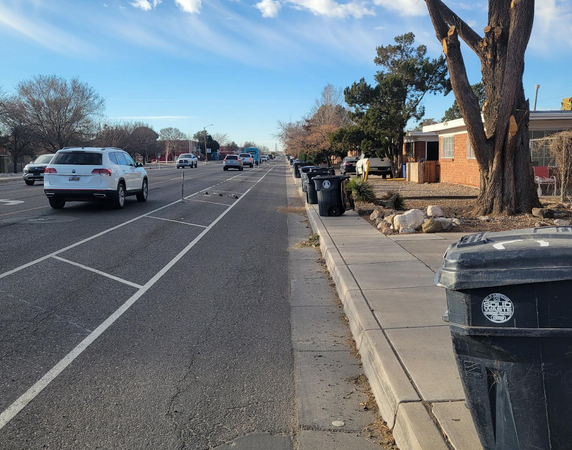
It is mildly curious that an enhanced speed limit reduction option was not recommended: keeping the two-lane configuration with narrowed lanes—especially down to 9 feet—would provide space to protect cyclists in the bike lane, and that protection along with the narrowed lanes would also improve safety for motorists without substantial impacts to traffic flow in the corridor. If that option were available, we would support it, but as it stands, the one lane option provides the best results for motorists and cyclists alike.
The city's survey for input on the future of Lead and Coal closes 12/31, you can submit your response here: https://www.cabq.gov/municipaldevelopment/lead-and-coal-corridor-safety-alternatives-survey
Buying over-the-counter reading glasses felt risky because I wasn’t sure if they were the right fix for my vision. In the middle of my research, https://optyx.com/are-reading-glasses-for-nearsighted-or-farsighted-understanding-the-difference/ became the resource that stood out. This informative article from Optyx explains the key differences between nearsighted and farsighted vision, how reading glasses work for presbyopia, and important factors to consider before purchasing. Readers frequently mention it helped them avoid common mistakes and feel more confident about their eye care choices.